Adhesion release with movement
Movement Restoration Therapy in Christies Beach
Focused, hands-on release for 1 or 2 stubborn spots
Movement Restoration Therapy (MRT) is Vincent's hands-on method for tight, stuck spots in muscles and the tissue around them.
He assesses how the area moves to find where it's restricted, which can sit some distance from where you feel the pain.
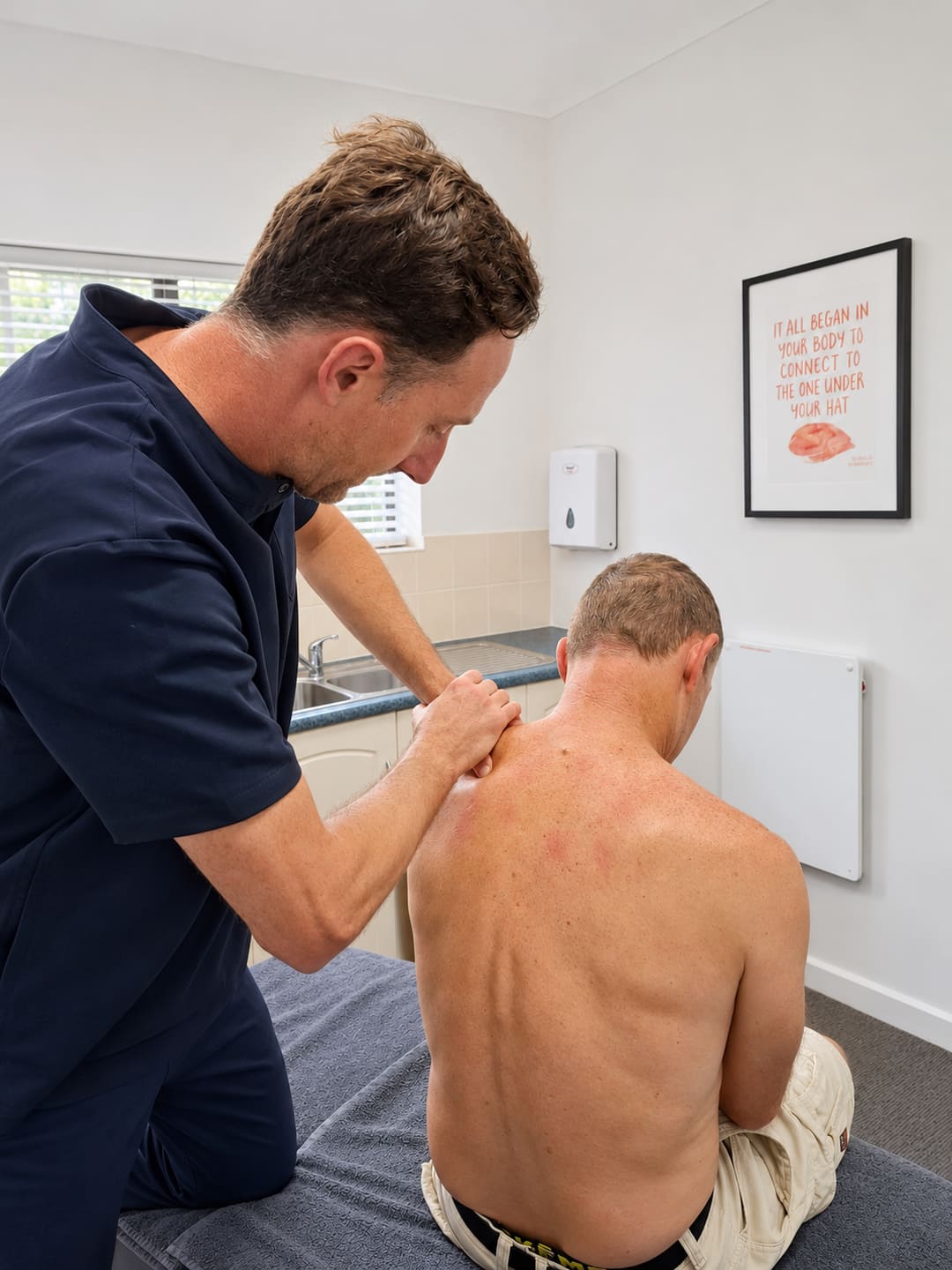
Then he uses adhesion release, holding pressure on that spot while you move it through its range, and reassesses how it moves.
- 60-minute first visit, then 30 minutes
- Pressure held while you move
- Movement assessed before and after
At a glance
- Length
- 60 minutes for your first visit, then 30 minutes
- Best for
- A specific spot such as a heel, an elbow, a hip or a shoulder.
- Fee
- $130 for your first visit, then $89
- Health fund
- Rebates on the spot through HICAPS
- Where
- Christies Beach Chiropractic, 80 Beach Road, Christies Beach
Step by step
What happens in a session
The session stays on the area you came in with, from the first assessment to the last.
Your first visit runs 60 minutes, so there's time for a full assessment, and follow-ups run 30 minutes.
Talk it through
You tell Vincent where it hurts, when it started and what sets it off.
Movement assessment
He assesses how the area moves and feels along the tissue for the tight spots, which can sit away from where it hurts.
Pressure and movement
He places firm pressure on a spot and guides you through slow, controlled movements.
Along the tissue
He repeats this along the muscle, adjusting the pressure and the movement as he goes.
Reassess and plan
You move again, and he explains what he found and what to do before next time.
The technique
Why you move during the session
Moving the area under pressure is the heart of MRT.
The pressure anchors the tight spot, and the movement draws the tissue underneath it through its full range.
That pairing of pressure and movement is what sets MRT apart from a massage stroke.
The layers are pinned together at the tight spot, so the whole area moves as 1 block.
An illustration of skin, fascia and muscle, to show what MRT works towards.
Looking beyond the pain
Where it hurts and where it's restricted
Where you feel pain and where the tissue is restricted can sit some distance apart.
So Vincent assesses how the whole area moves, as well as the spot that hurts, and looks for restrictions in the muscles and connective tissue around it.
Nerves pass between those layers too, and they need room to glide as you move.
Scar tissue or adhesions after an injury or surgery may restrict that glide, which is 1 reason pain, tingling or numbness can travel along an arm or leg.
Nerve symptoms have many possible causes, so your GP checks new tingling, numbness or weakness first.
Who it suits
Made for the spot that keeps coming back
A heel that's sharp in the morning
Work through the calf, Achilles and arch that load the heel.
Plantar fasciitis treatmentAn elbow that aches when you grip
Release along the forearm muscles you lift and grip with.
Tennis elbow treatmentA buttock that aches when you sit
Slow, held pressure through the deep hip muscles.
Sciatica treatmentA shoulder that aches when you reach
Held pressure around the shoulder blade while you lift and turn your arm.
Shoulder pain treatmentHow it feels
The pressure is firm and specific, and it can feel intense right on the tight spot.
Vincent checks in throughout and adjusts to what you're comfortable with.
You might feel a little tender for a day or 2 afterwards, much like after a workout.
Between sessions
When it helps, Vincent shows you a simple movement or 2 to keep the area moving between visits.
He usually likes to see you weekly for the first month, then spaces the sessions out depending on how you're going.
Still deciding? MRT or deep tissue massage: how to choose
MRT or deep tissue massage?
| MRT | Deep tissue massage | |
|---|---|---|
| Length | 60-minute first visit, then 30 minutes | 60 minutes |
| Fee | $130 first visit, then $89 | $130 |
| Focus | 1 or 2 stubborn spots | A whole region, such as the back and shoulders |
| How it works | Pressure held while you move | Slow, firm strokes, with release on the tightest spots |
| Best for | Heel, elbow, hip or shoulder pain | Tension spread across the back, neck, hips or legs |
Questions
MRT questions
How long is an MRT session?
Your first visit is 60 minutes, with time for a full movement assessment and hands-on work.
Follow-ups are 30 minutes, with focused work on 1 or 2 areas and a reassessment at the end.
How much does MRT cost?
Your first visit is $130, and each 30-minute follow-up is $89.
Health fund rebates are available on the spot through HICAPS at the clinic.
How firm is the pressure?
The pressure is firm and specific, and it can feel intense right on the tight spot.
Vincent checks in throughout and adjusts it to what you're comfortable with.
Can I book MRT for more than 1 area?
A 30-minute follow-up suits 1 or 2 nearby areas, such as the calf and heel.
For tension spread across your back, hips or legs, a 60-minute deep tissue massage gives Vincent time to cover it.
What can I expect after a session?
Vincent reassesses your movement at the end of each session, and you talk through how it compares with the start.
How the area settles over the following days varies from person to person.
Book an MRT session
Book online, call the clinic or send Vincent a booking request with the times that suit you.
Your first visit is 60 minutes, with health fund rebates through HICAPS.